Monday, November 17, 2014

Color Theory


A color scheme is an arrangement or combination of colors, typically used in design. Here are a few examples of the different types of color schemes. 

Monochromatic Colors: A monochromatic color scheme is a scheme with a single color in various hues. It is used due to being simple and easy to look at. Here is an example of this color scheme. 

Analogous Colors: A analogous color scheme is a scheme with colors next to each other on the color wheel. It is used because they typically match well and create a harmonious design. Here is an example of this color scheme. 

Complementary Colors: A complementary color scheme is a scheme with colors opposite of each other on the color wheel. It is used for its eye-catching look. Here is an example of this color scheme. 

Color Triads: A color triad scheme is a scheme with colors evenly spaced apart on the color wheel. It is used for its vibrancy. Here is an example of this color scheme. 

Split Complementary: A split complementary scheme is a scheme that is a slight variation to the complementary colors scheme, with a base color accented with two adjacent colors. It is used for its strong visual contrast. Here is an example of this color scheme. 

Monday, November 10, 2014

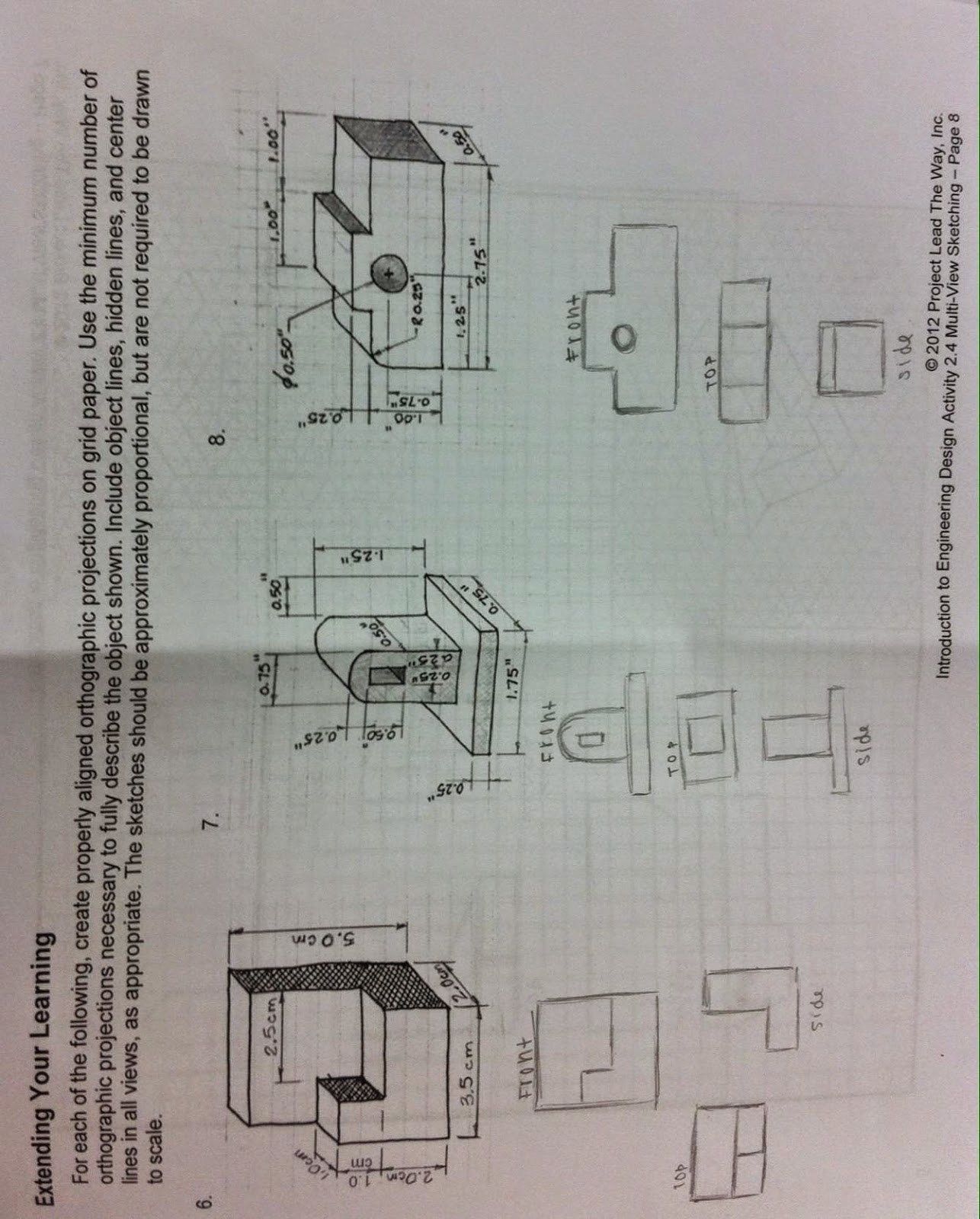
Multi-View Sketching

1). The purpose of construction and object lines is to act as a guide and help as you draw lins.

2). Hidden lines and center lines give the object more depth and proportion.


3). Perspective drawing is the type of pictorial shown in the first representation in number 2. You can because the lines converged.


4). The type of pictorial shown is isometric due to all angles being visible.


5). This is because multi-view drawings give the design more depth and detail, making it overall more clear and concise.


Monday, November 3, 2014

Concept Solution

Here is my finalized solution to my problem. In my presentation, I went over recycling statistics and explained my solution in detail, as well as providing a small little quiz to emphasize my problem, ie. it can be tricky figuring out what is trash and what is recyclable. Overall, I enjoyed this project, and I ended up learning a lot about recycling.

Wednesday, October 29, 2014

Reflection Interview #1

Today's video chat with an actual designer was definitely an experience. Not only was the Q&A informative and helpful, I liked how in a sense we were exploring career options. Most high schoolers still have yet to decide what they want to be, so it was definitely nice for a designer to talk to us about what it's like to be a designer. 

Friday, October 24, 2014

Revised Concept Sketch

Original Concept Sketch
Revised Concept Sketch 

Notes: 
  • Paper is made of easily attachable sticker paper
  • More items will be added to paper, the current list is only a generalized composition of items
  • Separate lists will be made for compost and trash bins as well, but due to my problem being linked to recycling, my primary focus is the recycling bin. 


Thursday, October 9, 2014

Solution


The act of recycling is an relatively easy task that leaves a relatively huge impact on the environment. Recycling reduces landfill waste, energy consumption, pollution, and overall cost. However, recycling can get confusing. It's not even a matter of common sense. Say I have a used tissue, do I trash it, or do I recycle it? It's technically paper, but it's also technically covered in snot. My solution to this is simple and cost effective; compile a list similar to this and have relevant information printed onto the recycle, trash, and compost bins respectively. In doing so, you'll essentially eliminate all recycling confusion.

Note: Don't recycle the used tissue, that's just nasty.


Thursday, October 2, 2014

Problems

1). People don't recycle.

2). The iPhone doesn't have a long battery life.


3). Locks are too inconvenient.